Five systems. One convergence. A named phase.
Wayfinder reads five independent systems against your specific birth data and threshold intake: Western Astrology, Vedic Astrology, Human Design, Gene Keys, and Numerology. The pattern is named only when multiple systems independently reach the same structural conclusion. That convergence is the method. It is what separates a Wayfinder field report from a single-system reading.
In plain termsFive different systems are read separately, then compared. Wayfinder only names something when several of them point to the same answer on their own. That agreement is what makes the read reliable instead of one person’s opinion.
The visible problem is rarely the whole pattern.
Every threshold condition has a structural signature. Wayfinder reads that signature from three independent sources and triangulates until the pattern resolves into a named phase.
The named phase is not a label. It is an orientation point – the difference between acting from confusion and acting from location.
Your intake maps the lived experience – what broke, what stopped consenting, what no longer fits. Not the symptom, but the structural signal underneath it.
Western and Vedic transits, Human Design conditioning, and Gene Keys shadow activations produce a timing signature independent of subjective experience. The pattern is verifiable whether you feel it or not.
The Personal Year number identifies the structural rhythm active now – whether this is a year of completion, initiation, consolidation, or expansion. This cycle confirms or contradicts what the other systems show.
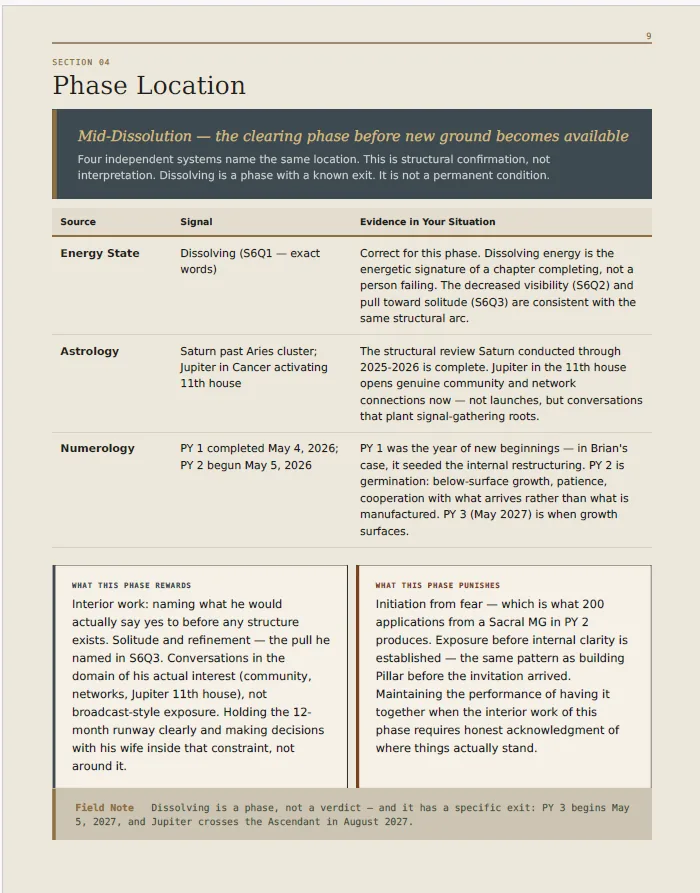
Named from convergence across Western transits, Vedic Dasha period, Human Design conditioning gates, and Personal Year 9. When five systems name the same structural condition independently, the confidence is structural – not intuitive.
Most people experiencing a threshold condition have already tried to name it themselves. They have frameworks – coaching models, therapy language, spiritual systems – but the naming has not produced stable orientation.
Wayfinder names the phase from the outside. From the convergence of systems that cannot be influenced by what you want the answer to be.
Every Wayfinder report includes a timing analysis drawn from five independent sources. The output is not prediction – it is structural location. Knowing where you are in the cycle determines what kind of action is structurally correct.
Most threshold decisions fail not because of wrong direction but because of wrong timing. The person was ready – but the structural window had not opened. Or it had passed and the action was taken in the wrong cycle.
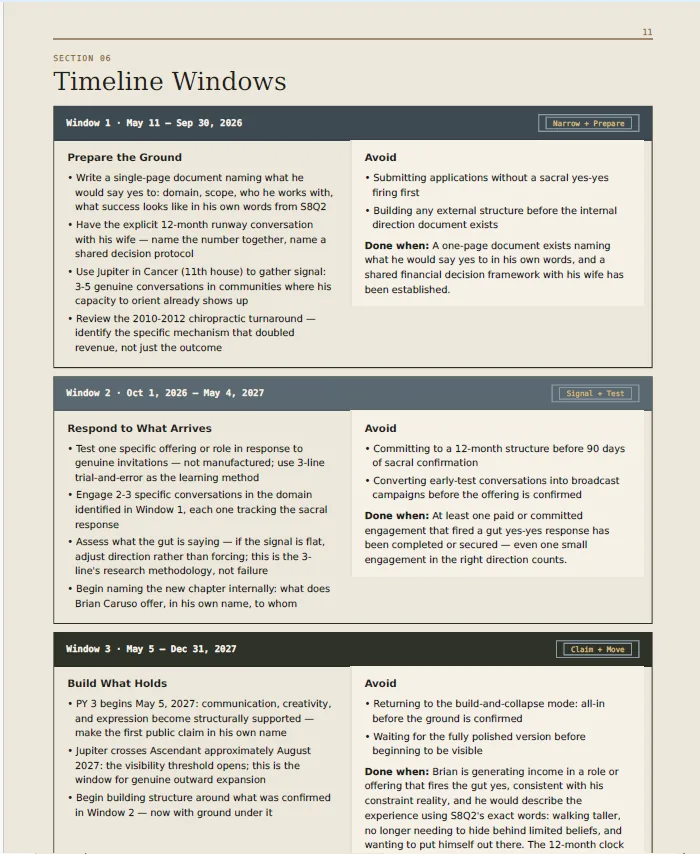
Wayfinder reads five timing sources and converges them into three actionable windows for the next 30 to 90 days.
Names the planetary period active now – the multi-year terrain you are moving through and what it structurally requires of you.
Identifies the current planetary conditions affecting your natal chart – where pressure is being applied right now.
Your intake provides the experiential anchor – confirming where the system data lands against what is actually happening in your life right now.
The Personal Year and Month numbers reveal the cycle active now – whether this is a window for release, consolidation, initiation, or expansion.
Every Wayfinder report delivers three named timing windows for the next 30 to 90 days – what each window structurally requires, and what kind of action belongs there.
The structural requirement is not action but reduction of noise. What to stop, hold, or release before the next window opens.
The first small moves become visible. Not full commitment – signal testing. What to try, touch, or begin that can be reversed if wrong.
The structural window for committed action. What the previous two windows have been preparing. The named move – and why this timing is structurally correct.
Clear boundaries are part of the method.
Wayfinder is a Stage I orientation instrument. That is a precise definition. These boundaries exist to protect the function.
- Generic astrology report
- Life coaching funnel
- Prediction service
- AI-generated personality PDF
- Dependency container
- Guru dynamic
- Stage I orientation instrument
- Convergence-based field report
- Decision-horizon narrowing
- Human-reviewed synthesis
- Defined endpoint
- Return of client authority
A few situations where Wayfinder is not the right tool.
- You are in an acute crisis or safety risk. This is not emergency or clinical care — contact a licensed provider first.
- You want a guaranteed outcome. Wayfinder names a pattern and a timing window, not a promise of what will happen.
- You are actively working this exact decision with a therapist or counselor. Loop them in — this is a one-time orientation input, not coordinated clinical care.
- You want an ongoing relationship or repeat sessions. The instrument is built to end, not continue.
- The decision on the table is legal, financial, or medical. Wayfinder is context for that conversation, not a substitute for the licensed professional making it with you.
How the method actually works
What are the five systems, in plain language?
Western Astrology (timing and psychological pattern), Vedic Astrology (a second, independent timing layer), Human Design (how your energy and decision-making are wired), Gene Keys (the developmental theme inside that wiring), and Numerology (the rhythm of the current year). Five lenses on the same person, read separately. See the glossary for each term.
Why use five systems instead of one?
A single system can flatter a hope or confirm a fear. When five independent systems are read blind and several land on the same structural conclusion, the result is far harder to argue with. The convergence is the signal; a lone system is just a data point.
What is a “named phase”?
It is the one-line structural description of where you actually are, e.g. “mid-dissolution” — the old structure is ending and the new one is not yet visible. Naming the phase is what turns confusion into a location you can act from.
Do I need my exact birth time?
It sharpens the read, especially the Human Design and house-based layers. If you do not have it, note that on intake; the work still proceeds, with the time-sensitive elements flagged rather than overstated.
Is this therapy, coaching, or fortune-telling?
None of the three. It does not treat conditions, run an ongoing program, or predict events. It orients you once, in writing, then ends. See how Wayfinder compares to therapy, coaching, and astrology readings.
Why not just get an astrology reading instead?
You can, and for plenty of questions that is enough. But a single system is one voice — it can flatter a hope or confirm a fear, and you have no way to check it against anything else. Wayfinder does not replace an astrology reading; it cross-checks two independent astrology traditions against Human Design, Gene Keys, and Numerology, plus your own lived intake, and only speaks where several of them land on the same answer without prior coordination. If you want one perspective quickly, a straight reading is the right, cheaper tool. If you are about to make a decision you cannot easily undo, convergence is what removes the guesswork of trusting one voice.